


Blog
UI vs EI Silicon Steel Lamination: What’s The Difference?

When designing transformers, inductors, and power electromagnetic components, selecting the right silicon steel lamination core is critical to device efficiency, stability, and manufacturing cost. EI and UI laminations are the two most widely used single-phase magnetic core structures in the electrical industry. Many buyers and engineers struggle to distinguish their structural differences, performance advantages, and application scenarios.
In this article, we will break down the core differences between UI and EI silicon steel laminations in structure, magnetic performance, assembly, cost, and applicable industries, helping you make the optimal selection for your projects.
Basic Structural Difference
EI Lamination
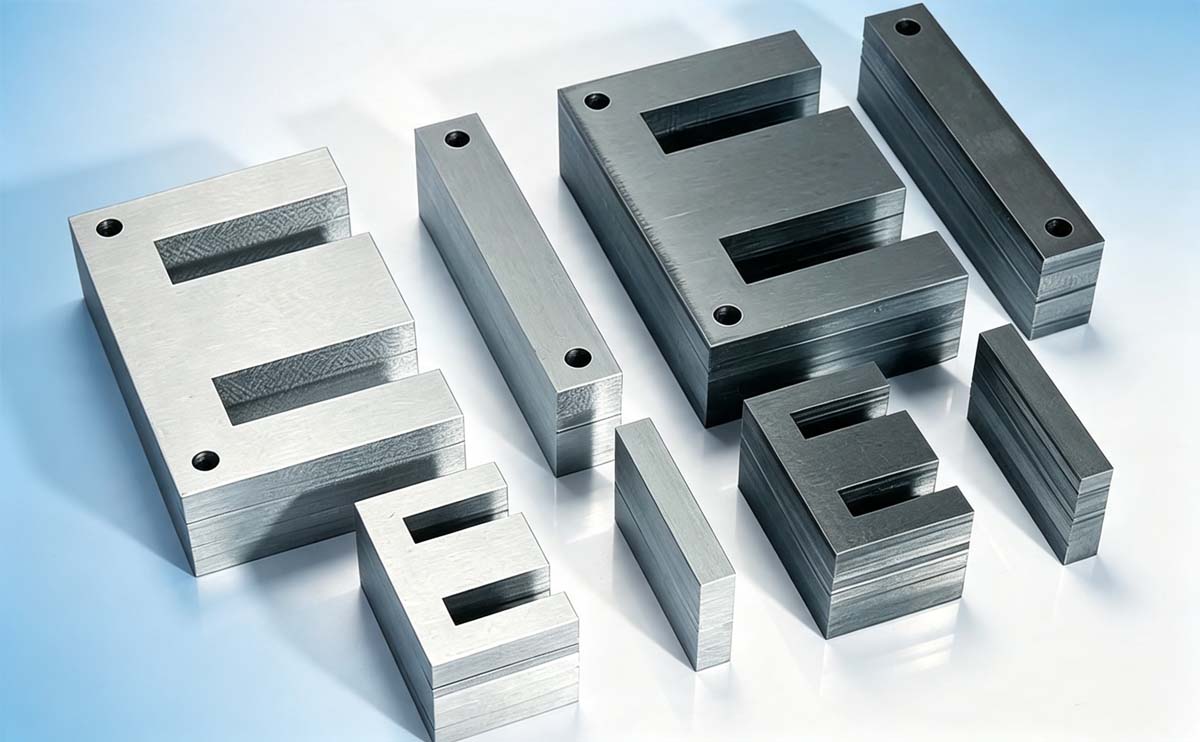
EI lamination consists of two parts: an E-shaped sheet and an I-shaped sheet. The E-shaped core has three parallel magnetic legs, with a symmetrical window structure on both sides. It is the most classic and mainstream magnetic core structure for single-phase electrical equipment.
The symmetrical structural design enables balanced magnetic circuit distribution, and the double-side window space provides sufficient winding area for copper coils, which is friendly for standardized mass production.
UI Lamination
UI lamination is composed of a U-shaped sheet and an I-shaped sheet. Different from the three-leg structure of EI cores, the UI core adopts a double-leg open magnetic circuit design with a larger and more open central window.
Its split structure features no intermediate partition, making coil installation and disassembly simpler and more flexible, especially suitable for customized winding and special-sized coil matching.
Magnetic Circuit & Working Performance Comparison
EI Core Performance
Benefiting from the symmetrical three-leg magnetic circuit, EI laminations deliver more uniform magnetic flux distribution, lower magnetic leakage, and stable electromagnetic performance. The closed symmetrical structure effectively restrains magnetic field divergence, reduces iron loss and eddy current loss during long-term operation, and ensures high working stability.
However, its compact structure leads to relatively higher coil leakage inductance, making it less suitable for ultra-high precision low-leakage scenarios.
UI Core Performance
UI laminations have a reasonable air gap design and smoother magnetic circuit transition. Compared with EI cores, they feature lower leakage inductance and higher magnetic permeability, which greatly improves the utilization rate of magnetic field energy.
The open structure brings slight magnetic leakage at the edges, but it has obvious advantages in high-frequency response and precise inductance control. It runs more stably in high-load and special-frequency working environments.
Assembly & Production Characteristics
EI Lamination
EI cores support fully standardized assembly. The unified E+I matching size realizes automated stamping, stacking and winding production. With high assembly efficiency and low manual error rate, it is extremely suitable for large-batch, standardized transformer and inductor production. In addition, the E-shaped structure can fully wrap the coil, providing better mechanical protection and heat dissipation conditions for internal windings.
UI Lamination
UI cores are more friendly for customized processing. The open U-shaped structure allows direct sleeve installation of pre-wound coils without complex threading operations, greatly reducing the difficulty of later replacement and maintenance. It is more adaptable for non-standard size, special specification and small-batch customized orders, with flexible processing and strong compatibility.
Application Scenarios (Core Selection Guide)
Best Applications for EI Laminations
- Standard low-frequency power transformers and control transformers
- Mass-produced power inductors, common-mode chokes
- Household electrical power supply equipment, industrial general power modules
- Scenarios requiring high cost performance and stable mass production
Best Applications for UI Laminations
- High-precision inductors and low-leakage transformer equipment
- UPS power supplies, welding equipment, and industrial special power devices
- Audio transformers and high-frequency electromagnetic components requiring high sensitivity
- Custom non-standard electrical equipment with special coil size requirements
Cost & Customization Flexibility
In terms of unit cost, standardized EI laminations have lower comprehensive costs due to mature production lines and large-scale shipments, making them the preferred choice for conventional mass production.
UI laminations focus on customized scenarios. Although the standard model cost is slightly higher, it can perfectly match special process requirements, reduce product debugging costs, and improve the overall yield of customized equipment. Both EI and UI cores can be produced with low iron loss silicon steel materials (CRGO/CRNGO), supporting customized thickness, insulation coating, stamping and cutting processing.
Quick Summary: EI vs UI Lamination
In terms of unit cost, standardized EI laminations have lower comprehensive costs due to mature production lines and large-scale shipments, making them the preferred choice for conventional mass production.
UI laminations focus on customized scenarios. Although the standard model cost is slightly higher, it can perfectly match special process requirements, reduce product debugging costs, and improve the overall yield of customized equipment. Both EI and UI cores can be produced with low iron loss silicon steel materials (CRGO/CRNGO), supporting customized thickness, insulation coating, stamping and cutting processing.
- Choose EI Lamination: For standard, mass-produced, cost-effective low-frequency transformers and inductors with stable magnetic circuit and low maintenance requirements.
- Choose UI Lamination: For customized, high-precision, low-leakage, high-frequency electrical equipment with flexible assembly and special performance demands.
Final Words
Both EI and UI silicon steel laminations are indispensable core components in the electromagnetic industry, with no absolute superiority or inferiority—only suitable or unsuitable for application scenarios. As a professional manufacturer of silicon steel laminations, Suzhou Lancelot Metal Products provides full-spec EI sheets, UI sheets, single-phase sheets, three-phase sheets, raw coils and custom cut sheets. We support OEM/ODM customized stamping, slitting and size processing to meet diverse customer design and production needs.